Introduction
📝 Author
Birat Aryal — birataryal.github.io
Created Date: 2026-03-22
Updated Date: Sunday 22nd March 2026 13:43:06
Website - birataryal.com.np
Repository - Birat Aryal
LinkedIn - Birat Aryal
DevSecOps Engineer | System Engineer | Cyber Security Analyst | Network Engineer
DevOps is the combination of sets of practices, philosophies, and tools that would increase the organizations ability to deliver applications and services faster. This sets of practice includes using traditional software development and infrastructure management process.
DevOps is distinguished mainly because of Continuous Integration and Continuously delivering products which support faster updates and development changes even for the minor changes. With the help of CI/CD pipelines sets of rules are defined which would govern all the Software Development Lifecycle process.
DevOps Lifecycle
Phase 1: Plan (Dev)
Before any project is started, the team would define what they are creating. Here, they define Goal, Key Activities, Tools Tools:* Jira, Click up
Phase 2: Code (Dev)
After the initial planning stage, developers would write code and publish it to the git repository whether it be deployed on the on-premise or cloud. Tools: GitHub, Gitlab, Bitbucket
Phase 3: Build (Dev)
Once the code is committed to the Version Control repository, it is pulled to the environment where it is build/compiled into an executable format. Tools: Maven, Gradle, Docker
Phase 4: Test (Dev)
Based on the codes pulled and the compiled package is generated. It would be tested either via the unit tests written on the code itself or smoke tests are done. So that no any bugs would be reported while deploying on the production environment. Tools: Selenium, Junit, SonarQube
Phase 5: Release (Ops)
Once all the tests are passed then it is ready to be deployed on the production environment. So, now which version is to be released on the production environment is looked over and approval for the deployment version is taken care of. Tools: Jenkins, GitLab CI.
Phase 6: Deploy (Ops)
Once received the versioning details and appropriate approval the product is then ready to be deployed on the production environment. So, that user would not face any issues while running the application/services. Tools: Terraform, Ansible, Kubernetes, Docker
Phase 7: Operate (Ops)
Once the code is live, then this phase involves the day to day management of the infrastructure hosting the application is to be managed. Tools: Ansible, PowerShell, Bash, Chef, Puppet
Phase 8: Monitor (Ops)
The data collected from the live application is analyzed, user behavior is understood then feedback is sent to the team for the optimization of the application. Which is now moves back to phase 1 (Plan stage) Tools: Prometheus, Grafana, ELK, Nagios
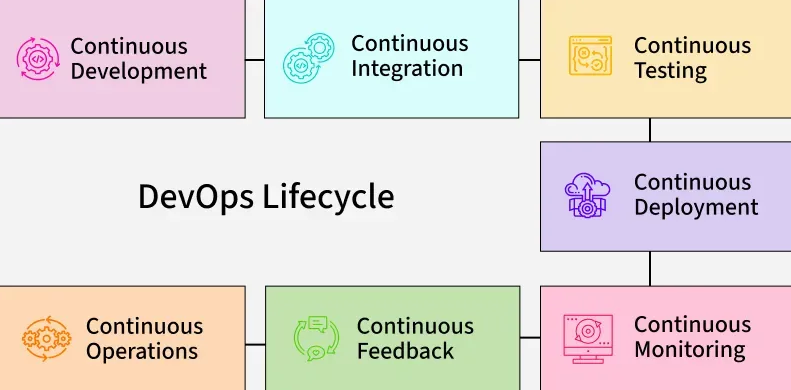
7Cs of DevOps
- Continuous Development
- Continuous Integration
- Continuous Testing
- Continuous Deployment/Continuous Delivery
- Continuous Monitoring
- Continuous Feedback
- Continuous Operations